Agile Commerce – that’s Forrester’s word for “Omnichannel,” right?
You’ve all heard the term “Omnichannel.” And since you are reading this blog I’m going to assume you’ve also all heard the term “Agile Commerce.” If not, then stop reading now and check out Welcome to the Era of Agile Commerce and Agile Commerce: Know it When You See It.
So either you are back, or you were with me all along. But now you are wondering “Ok, so what is the difference?” Let’s look at what the two terms really mean. Omnichannel doesn’t have a formal definition, though here’s what the oracle that is Wikipedia says…
“Omni-Channel Retailing is very similar to, and an evolution of, multi-channel retailing, but is concentrated more on a seamless approach to the consumer experience through all available shopping channels, i.e. mobile internet devices, computers, bricks-and-mortar, television, catalog, and so on.”
On the other hand, Forrester defines agile commerce as…
“An approach to commerce that enables businesses to optimize their people, processes, and technology to serve customers across all touchpoints.”
So superficially, they seem to be the samething, don’t they? They both espouse an approach that allows the customer freedom to interact with a brand on any touchpoint, however they want. But in reality, Agile Commerce is much more than that. Here’s why. The first thing that is wrong with Omnichannel is the name itself. Here’s a slide I presented recently at Internet Retailing 2012 to try and highlight what’s wrong. See if you can work it out…
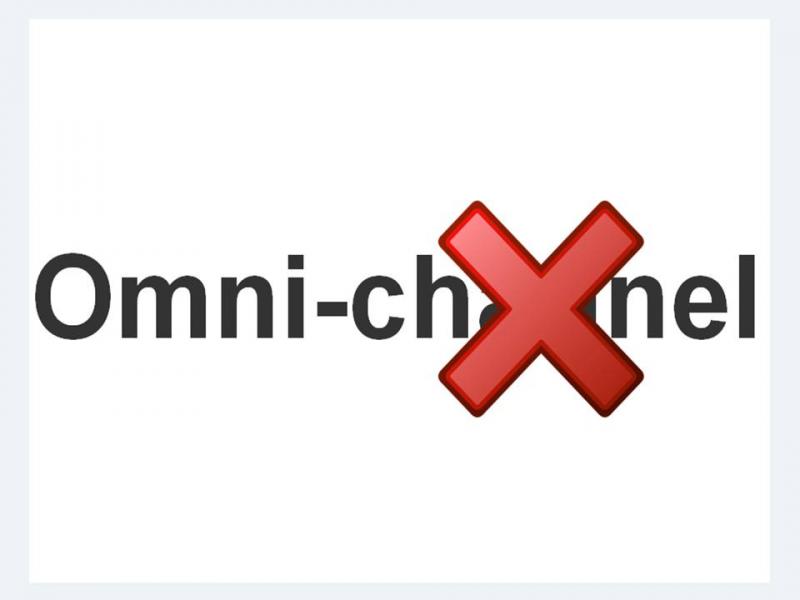
So here’s what’s wrong:
- The name itself continues to propagate a mindset of silos and separation. If multichannel is the Web and Stores (and maybe phone or catalogue), then Omnichannel includes social, mobile and other “new” stuff, doesn’t it? So if we have a web team, a stores team, a social team and a mobile team, then we are Omnichannel! Well…By contrast, Agile Commerce aims to break down organizational barriers and recommends a cross-functional approach, bringing new organizational constructs to bear such as organizing around the customer lifecycle. Agile Commerce is about breaking down silos, not inventing new ones.
- There are too many possibilities. Omnichannel says “serve the any-time, any-place, any-where customer how they want to be served.” The reality is that this is a flawed approach. To enable every experience on every touchpoint will only result in massive technical and process complexity at a high cost, all in order to serve a tiny portion of your customers who might never even want to book a holiday at 3am via their web enabled Renault Clio. On the other hand, Agile Commerce recommends you optimize the journey, not the touchpoint. By concentrating on common customer journeys then designing touchpoints within the context of those journeys, brands can create successful cross-touchpoint experiences for the vast majority of their valuable customers. Experiences that result in increased customer satisfaction, increased sales and an experience that differentiates in a way that supports the brand’s proposition. Agile Commerce is about reducing complexity, not increasing it.
- Change is the one constant. One thing we know without a shadow of a doubt is that the pace of change will only continue to increase. We are operating in the Age of the Customer, and empowered customers embrace new ways of interacting, new technologies and new touchpoints at massive speed. Think back to a decade ago. There were no smartphones. No tablets. No Facebook. No Pinterest. New touchpoints emerge out of nowhere and rise to mainstream adoption with increasingly short timescales. Omnichannel doesn’t give us much advice on how to manage this phenomenon, other than to embrace them (and potentially create more silos). Agile Commerce recommends that we embrace a mantra of constant change and that we organize our businesses to “Win Quick or Fail Fast” and “Learn by Doing,” embedding agility and customer insight into our teams and decision making processes. Agile Commerce is about, well…being agile.
These may seem like semantics, but I think goes beyond that. The concept of agility is critical to business. Our Agile Commerce research is based in the study of dozens of organizations that are embracing the complexity of 21st century business and are finding that there are four steps to agile commerce success. We outline these in our latest research into how firms are embracing an agile future.
Categories