
Technology Opens Doors To New Workplaces
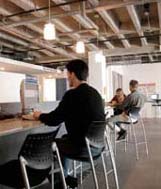
“Telecommuting” and flexible work spaces are nothing new. I’ve worked from home, from public libraries, airport lounges, and even Sun Microsystem’s iWork Cafes and drop-in centers for the past 10 years. Companies have been (and are increasingly) giving employees the flexibility to choose where they work. If someone wants to work from a cafe in the morning before a client meeting, reserve a table in the campus cafeteria for a chat with a colleague at noon, and work from a co-work or drop-in space near their child’s daycare at the end of the day, they can do that. What is new is the ability to reserve all of those different workspaces with a single tool – and in real time.
I had a great discussion with the team from LiquidSpace yesterday to learn more about how they work. They provide a marketplace for those with work spaces to offer and individuals looking for alternative work sites. “Just as Open Table is a platform used by restaurants, we are a similar real-time platform for workplaces,” explained Mark Gilbreath, the LiquidSpace CEO and co-founder. “We are not an owner of space. We are the tool to connect users and space.” And, those workplaces can include both public spaces – such as hotel meeting rooms, executive suites like Regus or co-work spaces – as well as private spaces on a company’s campus or meeting rooms within a residential building or development.
While co-work spaces are most used by freelancers and entrepreneurs, the LiquidSpace platform also addresses the increasing demand for space management by enterprises. Their real-time space management and transaction platform can be used by enterprises internally to facilitate flexible work policies allowing the reservation of on-campus spaces as well as providing access to a preferred selection of available co-work or other public spaces. Similar to the preferred hotels that business travelers reserve, employees can search for the location and amenities they need among their employers’ approved workspaces. And, just as enterprises subscribe to iPass for global Wi-Fi access, they may also provide employees with a “passport” to a global network of co-work facilities. “Passport” features such as type of space or time of day access may vary; suppliers determine their offers.
The Liquid Space tool differentiates between different types of work venues:
- Workspaces: assets that can be reserved in their entirety such as a conference room or a private office. A booking for a workspace takes the asset out of the inventory; it is no longer available to book.
- Neighborhood: multiple-user or large-capacity spaces such as a cafeteria or a drop-in center. An individual booking would only reserve a single space – a table in the cafeteria or workstation in the drop-in center. Bookings can be made up to the capacity of the room.
I look forward to a demo of the platform next week.
Co-Work Platforms Proliferate
There are a number of other platforms for reserving co-work space: Desks Near Me; DeskWanted, which started in Berlin; Neo-Nomade from Paris; and Open Desks, which started in Philadelphia, to name a few. With the occupancy of traditional office space declining, enterprise leaders are eager to rationalize their real-estate portfolios. Simultaneously, employees are increasingly “leaving the office to get work done.” And, these new platforms are literally opening the doors to new workplaces. I look forward to speaking to them about how they facilitate workplace/space transactions for my upcoming report on the workplace of the future.
But Co-Workspaces Are Not Just For Knowledge Workers
One question that has come up as we talk about creativity, innovation, and the future workplace is who does this apply to? Are we only talking about “knowledge workers” who just need a mobile device and an Internet connection? The answer is a resounding, “No.” Workspaces are changing for a wide range of professionals. No longer do chefs have to cook in their own kitchens, nor musicians record in their own garage studios, nor artisans build in their own workshops. And, more importantly, they don’t have to invest in their own equipment. They can share space and tools.
Here are a couple of examples I’ve found:
- Recording studios: MusicGym connects musicians to recording studio spaces in Boston and Austin.
- Kitchen space and tools: Forage Kitchen in San Francisco and KitchenShare in Portland provide kitchen facilities and equipment – dehydrators, canning equipment, ice cream makers, juicers, mixers, bread makers, etc. – for both professionals and nonprofessionals.
- Artist studios: Artelier and TransArtist facilitate the exchange of artist studios.

- Workshops: TechShop provides shared workspace for artisans, industrial designers, and just about anyone in need of serious tools such as laser cutters, welding stations, and water jet cutters to name a few. Fortunately they also offer training on these!
I’m collecting other examples of new workplaces and experiences with co-working across geographies and professional activities for my upcoming report. Please share.