
Redefining Your Greenfield: Existing Cities Find Greenfield Opportunities
Unfortunately, I will not able to deliver the keynote presentation at Forrester’s upcoming Infrastructure and Operations Forum in Paris as planned. The theme of the conference is “Redefining your greenfield,” and I was looking forward to sharing my observations of “greenfield” in the context of smart cities. So I thought I’d share some of my thoughts here.
A “greenfield” presents the opportunity to do things differently, to innovate. We often think of a greenfield as the clean slate, the ability to start from scratch, to create without the baggage of history, without existing infrastructure, without meddling stakeholders. We often hear of greenfields these days in the context of new cities – the massive infrastructure projects cropping up in the deserts of the Gulf region, or in Asia. In the IT world, we think of the entrepreneurial start up building out their infrastructure from ground up. Or even an emerging market with no technology legacy. But greenfield opportunities aren’t just for startups or emerging markets, and moreover, their grass isn’t always greener.
That’s not to say the promise isn’t appealing. The new, technology-enabled greenfield cities provide a clean slate, and the ability to test new technologies and practices. Think about:
- Networking across the city to facilitate home entertainment, telecommuting, remote diagnostics, eLearning, and eGovernment.
- Smart grids to respond more quickly to vagaries in electricity supply and demand, and to enable self-repairing networks.
- Integrated transport systems which offer single payment plans, and more passenger-friendly service such as using sensors and analytics to predict the arrival of a bus or train. Or available parking spaces that call out to passing drivers, who make their payments via SMS from the restaurant or office if the dinner or meeting runs longer than expected.
- Coordinated public safety systems which use sensor activated video surveillance cameras, video analytics and workflow to identify and route anything suspicious to the appropriate authorities.
- Smart buildings with smart meters, monitoring devices and sensors to connect heating, air conditioning, lighting, security systems, and other appliances in homes and businesses, enabling users to better track and control use of electricity and water.
- Even smart waste management where capacity sensors trigger waste removal, and electronic noses to detect toxicity in landfills… (I love the thought of an electronic nose.)
But fullscale buildouts are complex and expensive, and the “greenfield” isn’t always as green as expected. A few examples demonstrate the difficulties of a greenfield city:
- Take the case of Masdar in the United Arab Emirates: “Masdar cut 9 percent of its workforce after an annual business review. … After conducting an earlier strategic review, Masdar said last year it would build the city in stages and delayed the first phase by two years to 2015.”
- Or of Dongtan, China: “Yet for all its grand goals, this island city-to-be remains un-built. Whether China has abandoned the project totally is unclear.”
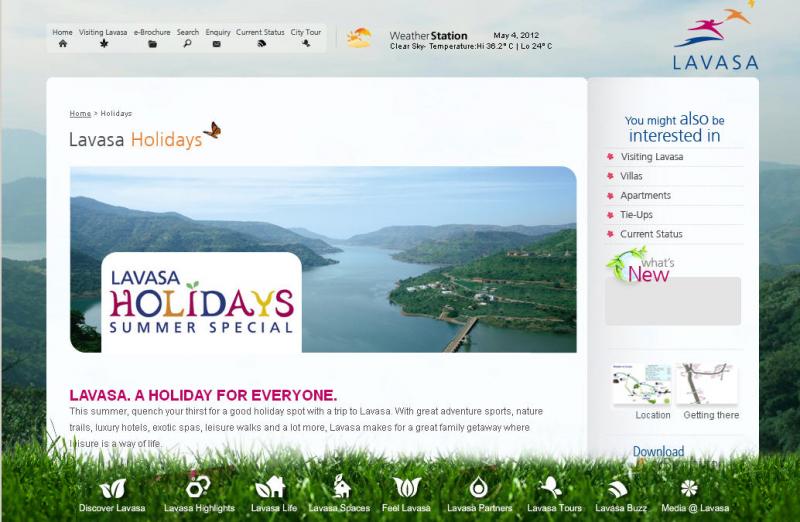
- Or of Lavasa– “’India’s first planned hill city’ is almost a ghost town. No families live in the over 500 half-constructed villas on the hilltops around Lavasa, while silence surrounds the restaurants and pubs that were meant to be bustling with customers.” In fact, Lavasa has started to advertise more as a resort than a real city.
Why isn’t the grass always greener in these cities? While there are a variety of reasons, a couple of them come to mind first:
- Entrenched stakeholders, conflicting interests and politics often top the list.
- Unforeseen complexity in planning and actual building due to supply issues, weather concerns, or changing specifications delay completion.
- And, scope creep and budget bulge challenge even the best planned projects.
On the other hand, many existing cities have successfully transformed themselves with new initiatives by creating their own “greenfields” driven by specific needs, policy concerns or cost pressures. Take a look at Rio de Janeiro or London or Madrid, or smaller cities like Chattanooga or Corpus Christi. Rio defined its “greenfield” to a focus on emergency management, a pressing need as the city addressed annual flooding. The city recently launched its new Centro de Operações Prefeitura Do Rio to better coordinate across city departments. London’s focus on transportation issues through Transport for London (TFL) –with congestion pricing, toll automatic payments, and improved public transportation—lead to a 70% reduction in car use throughout central London. Corpus Christi has focused on application and infrastructure consolidation, and creating shared services across city departments: their IBM Maximo asset management system is currently shared across 17 departments.
Like these cities, even the most established and mature companies have greenfield opportunities to reinvent themselves. Expansion into new geographies can provide greenfield opportunities. So can investments in rapidly moving technology areas such as mobility and collaboration; or new programs such as Bring Your Own Device (BYOD) or infrastructure and application consolidation, and shared services delivery. Greenfields are not limited to huge, complex, expensive projects. Greenfield opportunities are a means of doing things differently.
This idea of developing a greenfield is one that Forrester will continue to explore. Please feel free to share ideas and experiences.