
Looking Through The Cloud
SaaS vendors must collect customer insights for innovation and compliance.
 As of the end of last year, about 30% of companies from our Forrsights Software Survey, Q4 2011, were using some software-as-a-service (SaaS) solution; that number will grow to 45% by the end of 2012 and 60% by the end of 2013. The public cloud market for SaaS is the biggest and fastest-growing of all of the cloud markets ($33 billion in 2012, growing to $78 billion by the end of 2015).
However, most of this growth is based on the cannibalization of the on-premises software market; software companies need to build their cloud strategy or risk getting stuck in the much slower-growing traditional application market and falling behind the competition. This is no easy task, however. Implementing a cloud strategy involves a lot of changes for a software company in terms of products, processes, and people.
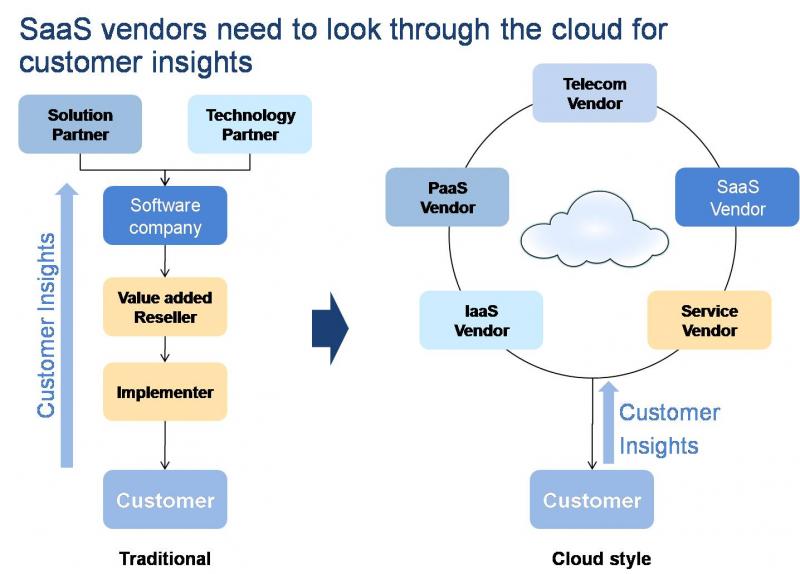
A successful SaaS strategy requires an open architecture (note: multitenancy is not a prerequisite for a SaaS solution from a definition point of view but is highly recommended for vendors for better scale) and a flexible business model that includes the appropriate sales incentive structure that will bring the momentum to the street. For the purposes of this post, I’d like to highlight the challenge that software vendors need to solve for sustainable growth in the SaaS market: maintaining and increasing customer insights.
Cloud-based licensing is different from traditional on-premises licensing. The traditional software sales cycle is very linear (RFI, RFP, contract, maintenance, handoff to an internal sales rep) and very static (see figure above). End users buy a license, but there is no continuous conversation with that customer. Today, SaaS vendors need to stay in constant contact with customers — something best done through an automated system that provides benefits to developers and customers alike:
- Manage ongoing, dynamic metrics. Because SaaS typically uses a subscription licensing model, vendors need to manage the ongoing license entitlement and application usage for the correct billing process. And because the trend is going from user-based pricing to more dynamic metrics, the need for and challenge of providing continous, automated usage tracking will only increase.
- Track customer usage for product innovation. With limited (if any) feedback from sales reps, resellers, or implementation partners, SaaS vendors urgently need customer insights gleaned from usage to improve their solutions and feed the fast innovation cycle that SaaS solutions need to follow. Constant usage tracking provides detailed feedback on popular, critical, or unused features and functions and helps firms better target R&D investments.
- Make gathering customer insights a two-way affair. Last, but certainly not least, customers will appreciate it if SaaS vendors play back some of their usage information, not only to monitor their license utilization but also to identify new opportunities, process optimization, and benchmark themselves against their peers.
Once continuous information about customer insights is available, it can be used for many more innovative opportunities, such as new value-added services and market differentiation for the SaaS vendor that turns the challenge of customer insights in the world of cloud computing into a business opportunity.
Please leave a comment or contact me directly.
Best regards, Holger