
Apple’s iCloud Takes The Lead In Pursuit Of The $12 Billion Personal Cloud Opportunity
Apple’s announcement of iCloud today coincides with the publishing of a major Forrester report for vendor strategists, “The Personal Cloud: Transforming Personal Computing, Mobile, And Web Markets” that describes the technology, markets, US market sizing, and the key players for this new form of personal computing that spans the job and personal lives. For a take on what Apple’s WWDC announcements mean for Consumer Product Strategists, please see the blog post, Apple’s iCloud Further Cements Platform Loyalty With Superior Total Product Experience, from my colleague Charlie Golvin.
The personal computing experience has become a major pain in the neck, as people add smartphones and tablets to the growing number of PCs they use at work and at home – more than half the US online population, about 135 million people, have the challenge of managing their content across multiple PCs and smartphones.
Forrester believes that a new computing experience is emerging, based on the personal cloud concept, that will redefine the computing experience around a user’s personal and work information, so that it’s seamlessly accessible across all of an individual’s devices. The growing personal cloud ecosystem is characterized by:
- A $12 billion market value by 2016, with $6 billion of it from direct subscription revenue.
- Apple leading Google on personal cloud innovation, while Microsoft, despite many assets, lags. Apple is innovating on par with the most notable startups in the personal cloud space, such as Dropbox, Box.net, and Evernote. We expect Amazon, Facebook, and other major players to pursue personal cloud strategies.
- The emergence of the personal cloud service as a third software platform for ISVs to code to, in addition to PCs and mobile devices, for creating the total end user experience.
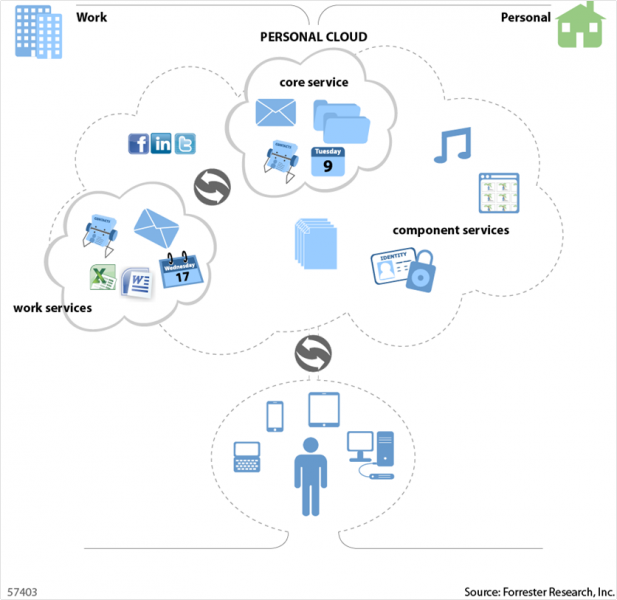
The notable elements of Apple’s WWDC announcements on iCloud are:
- Making iCloud the content hub of your digital life, rather than the Mac, for many but not yet all forms of content
- Making iCloud free for up to 5 GB of personal content such as documents, mail, and iOS backups (and excluding apps, photos, music, and videos, which are on your PC or in Apple servers).
- They had been charging $99 a year for much less capability in MobileMe. This means they aim to monetize mainly though software and hardware sales, rather than subscriptions – though you can buy more storage if 5 GB is not enough.
- Embedding personal cloud support deep into the Mac OS X and iOS, with APIs for developers, to create a seamless experience across all apps, rather than the separate experience of an add-on service. Bypassing the file system vastly simplifies the experience for users.
- Use of iCloud across ten(!) devices on the same Apple ID.
- Almost simultaneous implementation of personal cloud features in both Mac OS X Lion and iOS 5, with some support for Windows.
With the trifecta of iCloud, Mac OS X Lion, and iOS5, Apple takes the lead in personal cloud implementation and vision, with the broadest support across a user’s Macs, Windows PCs, iPhones, and iPads and deep support for third-party developer integration into iCloud. Google is worth watching as a number two player, but will struggle to match Apple as it tries to move the world’s apps into the Chrome browser. Microsoft, with no articulated vision for personal cloud and Windows 8 expected sometime in 2012, lags significantly. So Apple has lots of time to keep building momentum for its ecosystem of devices and cloud services.